
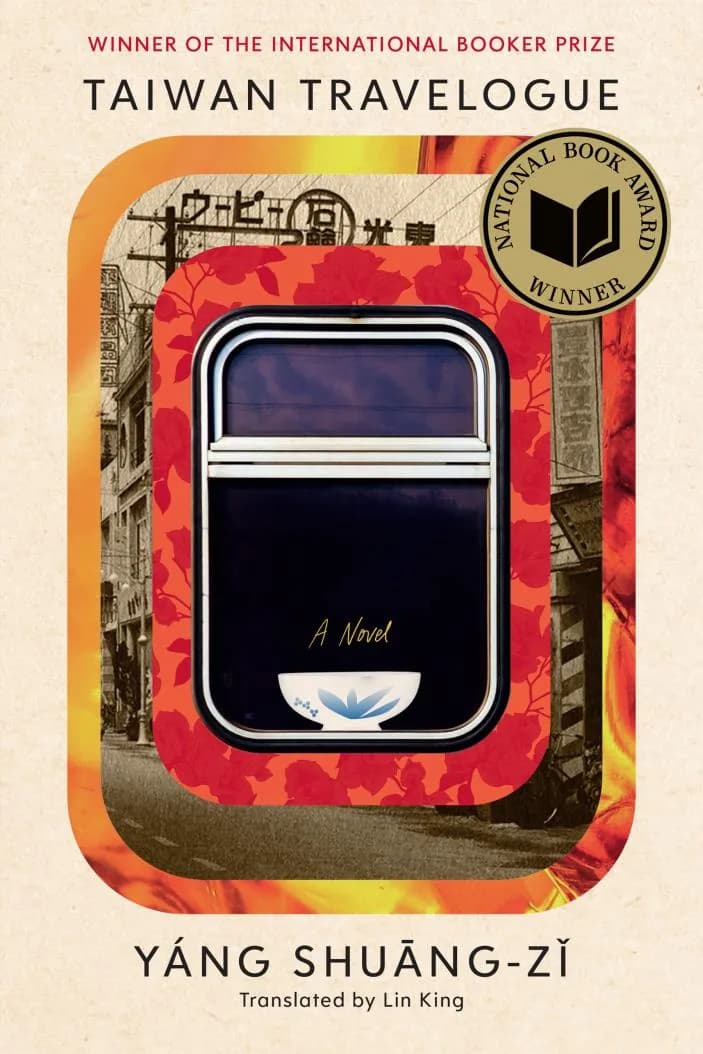
Taiwan Travelogue
by Yáng Shuāng-zǐ (translated by Lin King)
Book Club Date:June 2026
📖 Book Summary
In 1938, the thirteenth year of Shōwa, a film adaptation of Aoyama Chizuko's novel opens in Taiwan, and the colonial government invites the Kyushu-born writer over for a lecture tour. Her Taiwanese interpreter, Ō Chizuru, joins her, and the two ride the western trunk line south. They sleep in railway hotels, duck into street stalls, wander the markets, and eat their way down the island: minced pork with pickled gourd, curry rice, jute leaf soup. Taiwan Travelogue, a historical novel by Taiwanese author Yang Shuang-zi, looks like a steaming railway food tour. Through the daily companionship of two women who share one name, it peels back the power structure of a colony, the fates of women under it, and a feeling too faint to name. Yang goes further with the form itself. She frames the whole book as "fictional translated literature" and credits Aoyama Chizuko as the original author, turning a sleight of hand into a quiet question: who gets to speak for whom?
✍️ Reading Notes
Two "Chizurus" sit at the heart of the story. Aoyama Chizuko is warm, headstrong, and eats enough for three. The government pays for her trip, yet she refuses to cheer for the Empire's southern expansion. She insists on eating what the islanders eat and writing what the islanders live. Ō Chizuru can cook, translate, recite poetry, and manage everything in between, and she keeps a mask on that Aoyama cannot read. Aoyama believes each shared dish brings them one step closer. Food works as the book's most honest metaphor: you can eat across an entire island and still not understand it. Late in the novel, Ō Chizuru delivers her verdict. Between mainlanders and islanders, no friendship of equals can exist. Malice isn't what cuts deepest here. A kindness you cannot refuse does. When "look how good I am to you" rests on the hierarchy of colonizer and colonized, the goodwill itself turns into a weight the other person has to carry. Where the two women end up, you should find out on the page. The story outside the book moves me just as much. Twin sisters Yang Ruo-ci and Yang Ruo-hui shared the pen name "Yang Shuang-zi." Ruo-hui died of cancer in 2015, and her elder sister kept writing under their shared name alone. She dedicated the book's fictional translator to her sister's memory: a novel about two women mirroring each other, written by a woman who had lost her own mirror. The book then traveled farther than anyone expected. It won Taiwan's Golden Tripod Award. The Japanese edition took the Japan Translation Award. Lin King's English edition won the 2024 National Book Award for Translated Literature, then the 2026 International Booker Prize. Both were firsts for Taiwanese literature, and the Booker win made it the first Mandarin translation ever to take that prize.
💬 Discussion Points
- 1We're Taiwanese, so this book speaks to us on many levels. Why do you think it managed to travel into Europe and America and win readers there?
- 2Aoyama believed she treated Ō Chizuru with real sincerity, yet she never noticed the gap between them. Have you stood on the stronger side of a relationship (employer and employee, local and outsider, helper and helped) and assumed your kindness came with no strings?
- 3Yang Shuang-zi once described how Taiwanese people look back on the Japanese colonial period: distaste braided with nostalgia. What do you think produces that mix?