
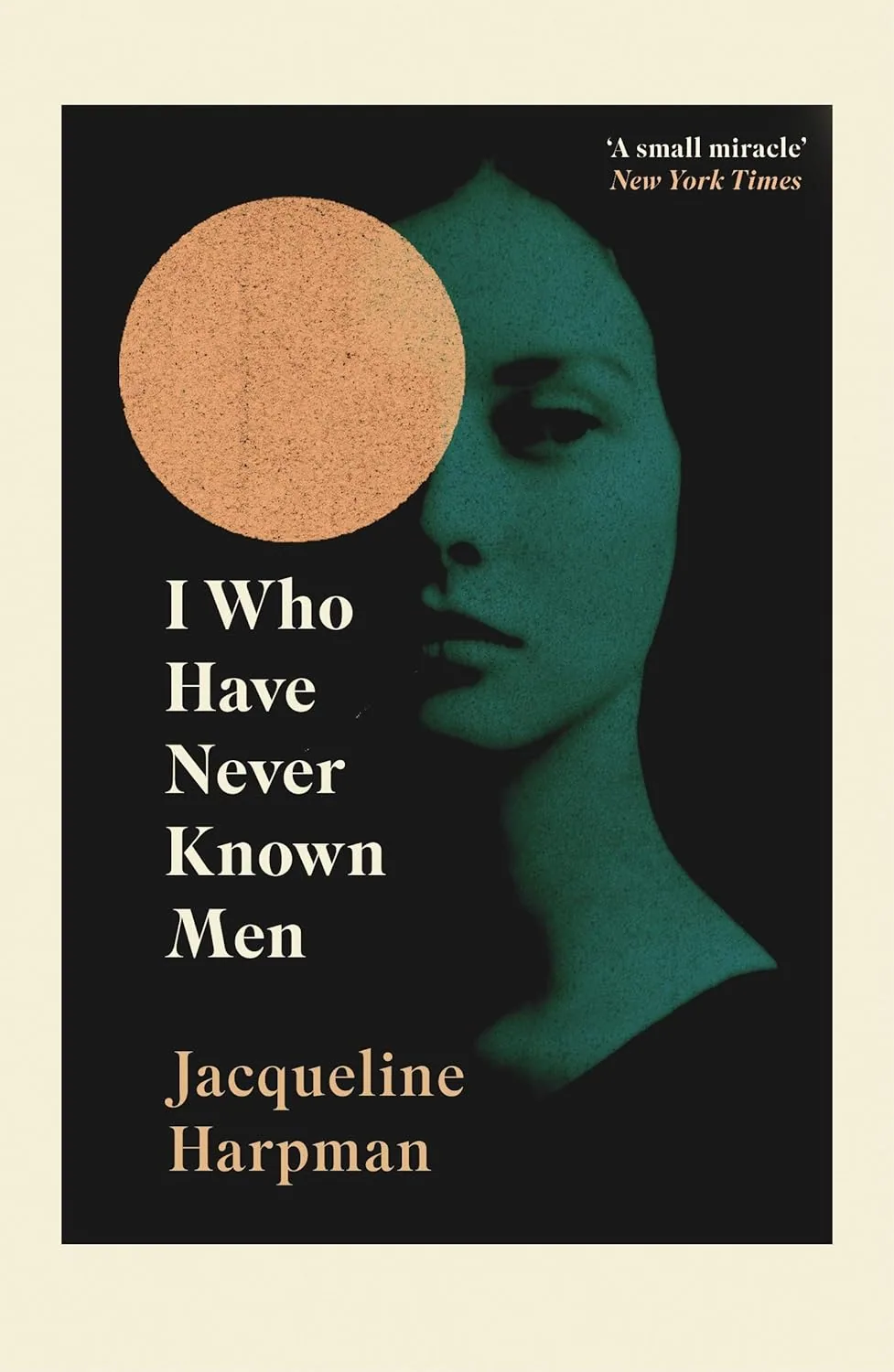
I Who Have Never Known Men
by Jacqueline Harpman
Book Club Date:July 2026
📖 Book Summary
I Who Have Never Known Men by Belgian author Jacqueline Harpman (1995) tells the story of forty women imprisoned in an underground cage under permanent artificial light, constantly watched by armed guards. No one knows why they are there. Among them is the youngest girl, who is unlike the others—her memories begin inside the cage. She has no experience of the outside world, no knowledge of civilization. Then one day, an alarm suddenly sounds, the guards disappear, and the women escape to the surface—only to find a world left in ruins.
✍️ Reading Notes
What makes this novel so remarkable is that it refuses almost every convention of dystopian fiction. It is often compared to The Handmaid's Tale, but the two novels ask very different questions. Margaret Atwood explores how an oppressive system comes into existence. Harpman refuses to explain anything at all. Why were they imprisoned? Who are the guards? Why has the world collapsed? The novel never answers these questions. Instead, Harpman places the reader in exactly the same position as the protagonist: knowing nothing, and destined never to know. This absence of explanation is not a flaw—it is the novel's method. Once every external answer is stripped away, only one question remains: if a person inherits no memories and belongs to no civilization, what still makes them human? The title itself is a carefully crafted misdirection. The protagonist claims she has "never known men," but men are only the starting point. In truth, she knows nothing about love, time, death, the body—or anything else we take for granted. Harpman was also a practicing psychoanalyst, and that background adds another fascinating layer. The protagonist becomes a kind of psychological experiment: a mind untouched by civilization. She invents time by counting her own heartbeat and learns emotions simply by observing other people. One particularly heartbreaking moment comes near the end, when the now elderly narrator reads the preface of a book and cannot understand why people in the old world apologized before sharing knowledge. To someone who once possessed nothing, anyone willing to teach you anything is offering a gift. She remembers Thaya, the woman who taught her everything she knew inside the cage, and cries for the first time. In this novel, knowledge is never merely a tool—it is one of the last expressions of human kindness. The novel becomes even richer when viewed alongside Harpman's own life. Born into a Jewish family, she fled to Casablanca during World War II to escape the Nazis. For her, the experience of seeing an entire group of people arbitrarily excluded from humanity was never an abstract idea. The novel's opening line—"My memory begins with anger"—carries an entirely different weight in that context. It is perhaps no coincidence that, after years of relative obscurity, the novel found new readers during the COVID-19 pandemic. A group of people confined without explanation, uncertain when—or whether—it will end, only to emerge into a world that no longer feels familiar. Readers of the 2020s discovered a resonance that Harpman herself could never have anticipated. Without giving away the ending, all I can say is that it is bittersweet rather than hopeless. The publisher's line captures its essence perfectly: "It turns out I have loved. I can feel pain. In the end, I am human too."
💬 Discussion Points
- 1Throughout the novel, the protagonist is never taught what a woman is "supposed" to be. If a woman grows up without any social expectations about gender, how might she understand her own identity? And without any education at all, how would we come to understand our own bodies?
- 2The title says I Who Have Never Known Men. What do you think "men" actually represents? Is it simply men themselves, or does it symbolize the patriarchal structures of society, or perhaps something even broader about the human experience?
- 3One character insists that they cannot continue living like parasites in the cellar; they must "remain human." After finishing the novel, what do you think it truly means to live as a human being?